

URL :

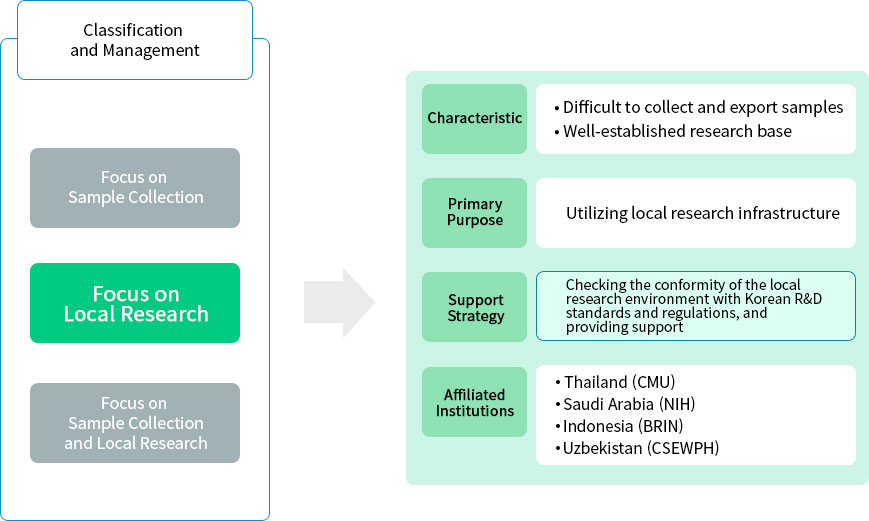
Focus on Local Research

Network for Local Research: Countries from Group B does not follow the Nagoya Protocol or are parties that do not establish procedures or relevant institutions. Thus, there are difficulties in collecting samples and taking them out of the country; however, local research is available since the local research foundation is well-established. INID-K aims to utilize local research infrastructure by checking compliance with domestic (Korean) R&D standards and regulations. Especially, the goal is to collect additional genetic information of the resources secured.

Thailand

Chiang Mai University

Prapan Jutavijittum
Prapan Jutavijittum
  • Affiliation: Faculty of Medicine, Chiang Mai University, Thailand
  • Position: Associate Professor Prapan Jutavijittum, MD
  • The Faculty of Medicine at Chiang Mai University, established in 1964, is one of Thailand’s leading medical schools and the first major higher education institution founded in northern Thailand. Its geographic and climatic conditions support strong epidemiological surveillance and infectious disease research, providing access to diverse clinical samples and field-based data. Located at the center of the Indochina Peninsula, the university serves as a regional hub for collaborative infectious disease research with neighboring countries such as Myanmar, Laos, Cambodia, Vietnam, and Malaysia.


Saudi Arabia

National Institute of Health (NIH), Saudi Arabia

Majed Al Jeraisy
Majed Al Jeraisy
  • Affiliation: Saudi National Institute of Health, KSA
  • Position: Executive Director of Research
  • The National Institute of Health (NIH) Saudi Arabia is a key national public health research institution leading responses to region-specific infectious diseases, including MERS. As a national reference laboratory, it conducts surveillance, diagnostics, and analysis of high-risk pathogens, supporting evidence-based public health policies and response strategies for emerging and re-emerging infectious diseases. The institute also contributes to strengthening infectious disease response capacity in the Middle East through international research collaborations.

Indonesia

National Research and Innovation Agency (BRIN)

Harimat Hendarwan
Harimat Hendarwan
  • Affiliation: Indonesia National Research and Innovation Agency (BRIN)
  • Position: Head of Research Center for Preclinical and Clinical Medicine, Research Organization for Health
  • The National Research and Innovation Agency (BRIN) serves as Indonesia’s central coordinating body for national research and development across science, technology, and health sectors. In the field of infectious diseases, BRIN guides research priorities on major public health challenges such as malaria, tuberculosis, and dengue, while connecting national research infrastructure and expertise to advance diagnostics, prevention, and response strategies. BRIN also promotes the translation of research outcomes into policy and practice and strengthens regional and global collaboration in infectious disease research.

Uzbekistan

The Republican Specialized Scientific and Practical Medical Center for Epidemiology, Microbiology, Infectious Diseases and Parasitic Diseases

Laziz Tuychiev
Laziz Tuychiev
  • Affiliation: Research Institute of Virology (RIV), Tashkent, Uzbekistan
  • Position: Vice-Director, Professor
  • The Center for Sanitary-Epidemiological Welfare and Public Health (CSEWPH) is Uzbekistan’s key national institution responsible for infectious disease surveillance and public health response. As the central body of the national disease monitoring system, it conducts integrated activities including pathogen monitoring, epidemiological investigations, and laboratory diagnostics to address tuberculosis and various viral infectious diseases. Through collaboration with neighboring countries and international partners, CSEWPH also serves as a regional hub for strengthening infectious disease response in Central Asia.