

URL :

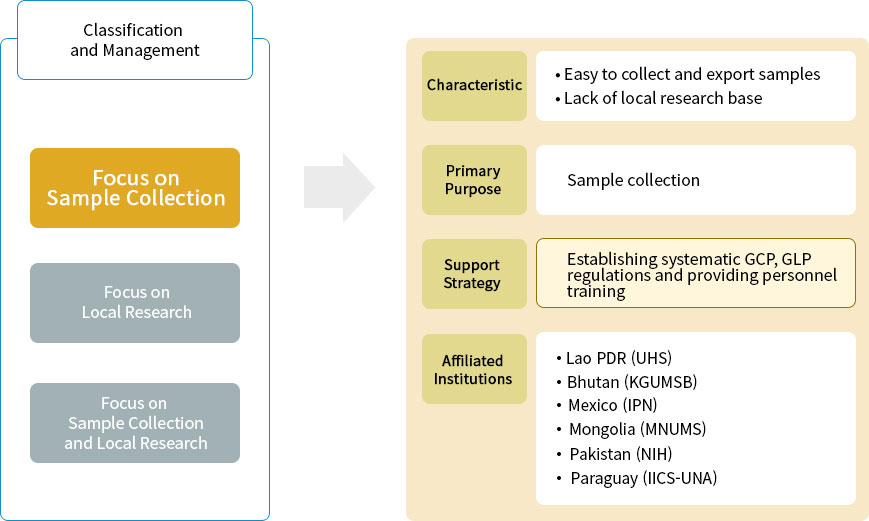
Focus on Sample Collection

Network for Sample Collection: Countries from Group A does not follow the Nagoya Protocol or are parties that do not establish procedures or relevant institutions. Thus, there are difficulties in collecting samples and taking them out of the country, and the foundation for local research is also insufficient. INID-K aims to ensure valid and reliable sample collection over the network by supporting the establishment of SOPs that meet GCP and GLP standards and staff training.

Lao PDR

University of Health Sciences (UHS)

Angkham Ounavong
Angkham Ounavong
  • Affiliation: Institute of Research and Education Development, University of Health Sciences, Lao PDR
  • Position: Deputy-director of IRED
  • The University of Health Sciences (UHS) in Laos is a government-affiliated institution established in 2007 to provide education and training in health sciences. The university includes faculties of basic sciences, medicine, pharmacy, dentistry, nursing, and medical technology, supporting a broad range of healthcare education and research.
  • UHS actively participates in international collaborations in infectious diseases and public health. In partnership with Korea and other countries, the university has been involved in programs such as the Lee Jong-wook Fellowship and initiatives to strengthen maternal and child health systems, as well as infectious disease diagnostics and specimen management capacity in Laos.


Bhutan

Khesar Gyalpo University of Medical Sciences of Bhutan (KGUMSB)

Rixin Jamtsho
Rixin Jamtsho
  • Affiliation: Medical Education Centre for Research, Innovation and Training (MECRIT) at Khesar Gyalpo University of Medical Sciences of Bhutan (KGUMSB)
  • Position: Director
  • Khesar Gyalpo University of Medical Sciences of Bhutan (KGUMSB) is the first and only medical university in Bhutan, leading medical education and the training of healthcare professionals in the country. The university provides education and research across a wide range of health disciplines, including medicine, nursing, and public health, while strengthening medical education and evaluation systems. Through its research centers and collaborations with national and international partners, KGUMSB conducts research on infectious disease epidemiology, diagnostics, and prevention, contributing to vaccine research and the advancement of Bhutan’s public health system.

Mexico

Instituto Politécnico Nacional (IPN)

Carlos Ignacio Machain Williams
  • Affiliation: Instituto Politécnico Nacional
  • Position: Researcher
  • Instituto Politécnico Nacional (IPN) is one of the largest public science and technology universities in Mexico, based in Mexico City, conducting education and research across a wide range of disciplines including engineering, natural sciences, and health sciences. Through its medical and biomedical research institutes, IPN carries out both basic and applied research on infectious diseases and tropical illnesses, while contributing to national efforts in vaccine development and virology research infrastructure. Advanced facilities such as the National Laboratory of Vaccinology and Tropical Viruses support the development of technologies for the prevention, diagnosis, and treatment of tropical viral diseases.

Mongolia

Mongolian National University of Medical Sciences (MNUMS)

Ravjir Oyungerel
Ravjir Oyungerel
  • Affiliation: Infectious diseases department, School of Medicine, Mongolian National University of Medical Sciences
  • Position: Associate professor
  • The Mongolian National University of Medical Sciences (MNUMS), established in 1942, is Mongolia's leading institution for medical education and research, training healthcare professionals in medicine, biomedical sciences, and public health. Through its public health and molecular diagnostics research institutes, MNUMS conducts research on infectious disease diagnostics, epidemiology, and prevention. During the COVID-19 pandemic, the university contributed to large-scale PCR testing and the expansion of molecular diagnostic capacity, and continues to strengthen infectious disease response through international research and educational collaborations.

Pakistan

National Institutes of Health (NIH), Pakistan

Nazish Badar
Nazish Badar
  • Affiliation: National Influenza Centre (NIC), National Institute of Health, Pakistan
  • Position: Laboratory Coordinator
  • The National Institutes of Health (NIH) Pakistan is the country’s leading public health research institution responsible for infectious disease surveillance, diagnostics, and research. It plays a central role in responding to public health threats by conducting laboratory diagnostics and epidemiological studies on diseases such as polio, tuberculosis, viral hepatitis, and emerging infectious diseases. Through collaboration with international research networks, NIH Pakistan continues to strengthen regional and global capacity for infectious disease prevention and response.

Paraguay

Instituto de Investigaciones en Ciencias de la Salud – Universidad Nacional de Asunción (IICS-UNA)

Magaly Martinez
Magaly Martinez
  • Affiliation: Instituto de Investigaciones en Ciencias de la Salud-UNA (IICS – UNA)
  • Position: Senior Researcher
  • The Instituto de Investigaciones en Ciencias de la Salud (IICS-UNA) is a health sciences research institute affiliated with the National University of Asunción in Paraguay, conducting field-oriented research in infectious disease diagnostics and public health. The institute focuses on major infectious diseases in Latin America, including dengue, chikungunya, and Zika virus, carrying out laboratory-based studies and epidemiological investigations. Through collaboration with national and international research institutions, IICS-UNA continues to strengthen research capacity and responses to infectious diseases.